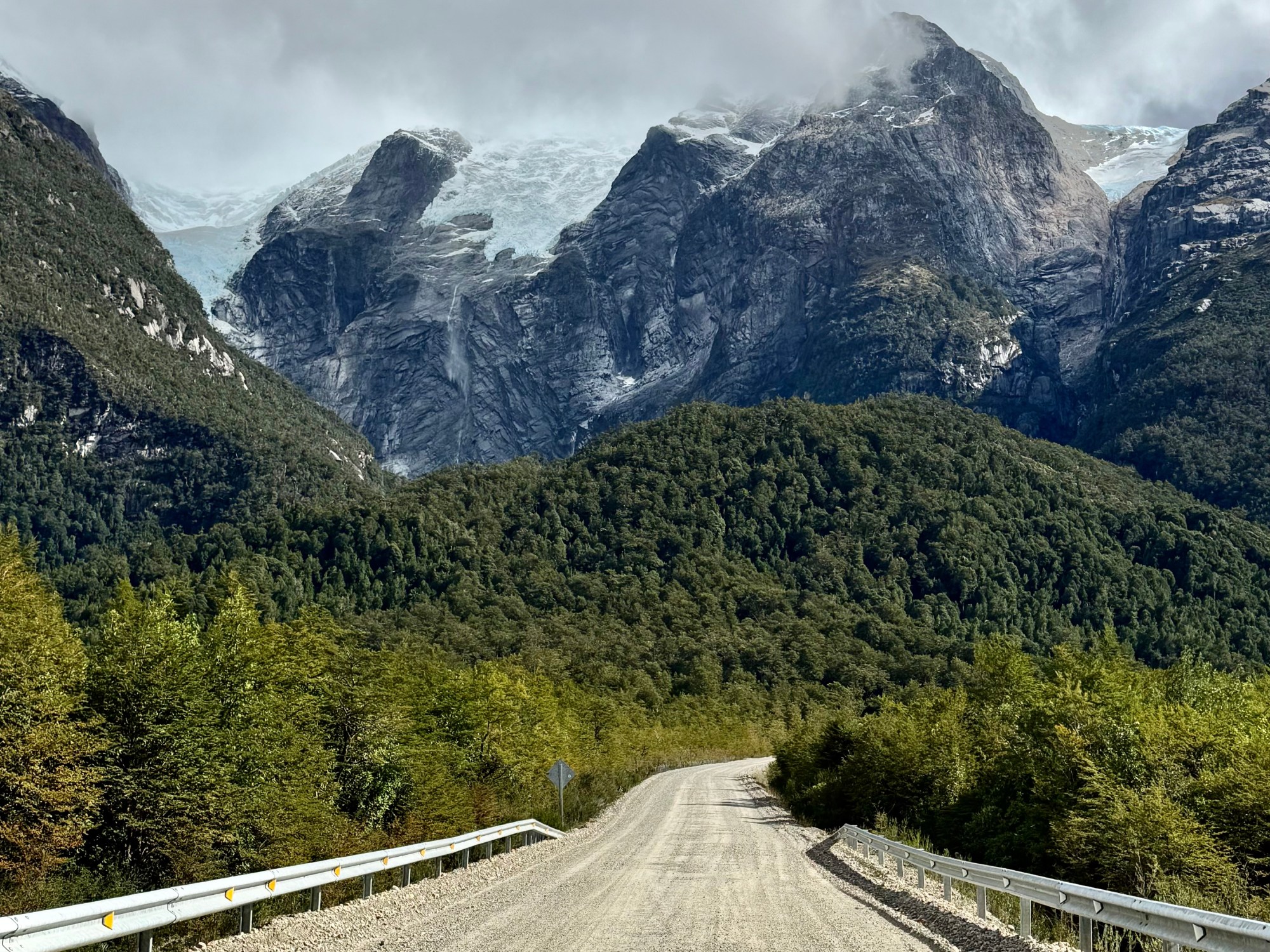
One of the world’s most celebrated road trips owes its existence to a dictator’s obsession. It was the 1970s, and Augusto Pinochet had just staged a brutal military coup to take control of Chile. Like many despots, he was paranoid: Among his greatest fears was that the isolated south might one day drift into Argentina’s orbit. So, in 1976, he ordered the construction of an audacious highway running latitudinally through Northern Patagonia, a land where craggy mountains crumble into fjords, volcanoes poke through clouds, and dense rainforests swallow the light.
The resulting Carretera Austral (Southern Highway in English) bound together that distant frontier to the Chilean state by force of gravel, dynamite, and military will. Today, it begins at an inlet of the Pacific, near the port city of Puerto Montt, and ends—770 miles and four car ferries later—in the frontier outpost of Villa O’Higgins. Fifty years after construction began, surrounding communities are taking stock of what the road has delivered and what the decades ahead might bring as it increasingly draws tourists to natural wonders along the route.
In early April, I flew from my home in Santiago to the lone commercial airport along the Carretera Austral, just outside the four-block outpost of Balmaceda. The road south from Balmaceda unspools for 45 miles through snaggletooth peaks and wind-combed valleys, before arriving at Villa Cerro Castillo, an eight-block village dwarfed by its namesake massif. Until the 1970s, towns like this in Chile’s sparsely populated Aysén Region were effectively cut off from the rest of the country. To get around, ranchers relied on horses, boats, and remote airstrips, and access to goods and services was limited. The Carretera Austral changed everything … (continue reading at Condé Nast Traveler or via the PDF HERE).

